 11
11To understand the positioning of the CyberPowerPC Gamer Master, one must first analyze the broader economic factors influencing PC hardware in early 2026. The industry is currently emerging from a memory crisis that has seen 32GB DDR5 kits reach prices exceeding $\$400$, a development that has radically altered the value calculation for both DIY builders and prebuilt manufacturers. This environment has favored system integrators like CyberPowerPC, whose bulk purchasing agreements allow them to offer configurations that would be prohibitively expensive to replicate in the retail market. The Gamer Master series utilizes the AM5 socket, providing a critical hedge against obsolescence by offering a clear upgrade path as component prices stabilize and newer Ryzen iterations enter the market.
The introduction of the NVIDIA GeForce RTX 50-series, based on the Blackwell architecture, represents the most significant generational leap in graphics processing since the transition to ray tracing. By integrating the RTX 5060 Ti, CyberPowerPC has targeted a mid-range demographic that seeks the latest AI-enhanced features, such as DLSS 4 and Multi-Frame Generation, without incurring the extreme costs associated with flagship enthusiast hardware like the RTX 5090.
The selection of the AMD Ryzen 5 8400F as the primary CPU for this configuration is a calculated move to balance performance with platform longevity. As a member of the Ryzen 8000 series, specifically the “Phoenix” family, the 8400F is a six-core, twelve-thread processor that omits the integrated graphics found in the G-series variants. This omission is logically sound for a gaming desktop equipped with a discrete RTX 5060 Ti, as it reduces the manufacturing cost while maintaining the core processing power required for high-fidelity gaming.
| Parameter | Specification Details |
| Core / Thread Count |
6 Cores / 12 Threads |
| Base Clock Frequency |
4.2 GHz |
| Maximum Boost Clock |
4.7 GHz |
| Total L3 Cache |
16 MB |
| Total L2 Cache |
6 MB |
| Process Technology |
TSMC 4nm FinFET |
| Thermal Design Power (TDP) |
65 W (Configurable to 45 W) |
| Maximum Junction Temperature ($T_{jmax}$) |
95 °C |
| Memory Support |
DDR5 (Up to 256 GB) |
| PCIe Version |
PCIe 4.0 |
In synthetic evaluations, the Ryzen 5 8400F demonstrates a robust performance profile that exceeds the requirements of modern gaming. On the CPU Mark charts, the 8400F achieves an average score of 24,486, placing it comfortably above the legendary Ryzen 5 5600X (21,843) and the Intel Core i5-12400F (19,582). In single-threaded operations, which are crucial for gaming responsiveness, the 8400F reaches a rating of 3,689 MOps/Sec, outperforming the Ryzen 9 5900X in this specific metric.
However, when compared to the Ryzen 5 7500F or 7600X, the 8400F’s reliance on the Phoenix die—originally intended for mobile applications—becomes apparent in its cache structure. The 16 MB of L3 cache is half that of the Ryzen 5 7600, which can lead to performance deficits in titles that are sensitive to cache latency. Despite this, the 4.7 GHz boost clock ensures that in most gaming scenarios, the CPU does not act as a bottleneck for the RTX 5060 Ti, especially at 1440p resolutions where the graphical load increases relative to the computational load.
The centerpiece of the CyberPowerPC Gamer Master is the NVIDIA GeForce RTX 5060 Ti, a performance-segment card based on the Blackwell architecture. Released in April 2025, the 5060 Ti utilizes the GB206 graphics processor, manufactured on the specialized TSMC 4N process. This architecture represents a significant departure from the Ada Lovelace generation, emphasizing AI-powered neural rendering and improved power efficiency.
The GB206-300 die used in the RTX 5060 Ti features 36 Streaming Multiprocessors (SMs), which translates to 4,608 CUDA cores. This is a modest 5.8% increase in core count over the RTX 4060 Ti, but the true performance gains are derived from architectural improvements in the Tensor and Ray Tracing cores. The introduction of 5th-generation Tensor cores enables support for FP4 precision, significantly accelerating AI workloads and providing the foundation for DLSS 4.
Perhaps the most impactful technical specification is the transition to GDDR7 memory. Running at an effective speed of 28 Gbps on a 128-bit bus, the RTX 5060 Ti achieves a peak bandwidth of 448 GB/s—a 55% improvement over the GDDR6 memory found in its predecessor. This bandwidth uplift is critical for maintaining high frame rates at 1440p and mitigating the bottlenecks that occasionally hindered the 40-series mainstream cards in high-resolution textures.
| Feature | NVIDIA GeForce RTX 5060 Ti Specification |
| GPU Architecture |
Blackwell (GB206) |
| Fabrication Process |
TSMC 4N |
| CUDA Cores |
4,608 |
| Tensor Cores |
144 (5th Gen) |
| RT Cores |
36 (4th Gen) |
| Base / Boost Clock |
2.41 GHz / 2.57 GHz |
| Memory Configuration |
8 GB or 16 GB GDDR7 |
| Memory Speed |
28 Gbps |
| Total Graphics Power (TGP) |
180 W |
| Interface |
PCIe 5.0 x8 |
A major point of contention within the hardware community is the availability of both 8GB and 16GB variants of the RTX 5060 Ti. Data from detailed benchmarks suggests that while the 8GB model remains sufficient for 1080p gaming at medium settings, it faces significant challenges when pushed to ultra settings or 1440p resolutions in VRAM-intensive titles. InIndiana Jones and the Great Circle*, the 8GB card proved completely unplayable at 4K ultra settings (1.3 FPS), while the 16GB model maintained functional, albeit low, frame rates. For the CyberPowerPC Gamer Master, the choice of VRAM capacity significantly dictates the system’s “future-proofing” potential, with the 16GB variant offering a 66% better price-to-performance ratio at 4K than the 8GB model.
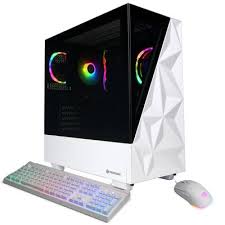
CyberPowerPC has recently overhauled the aesthetics of the Gamer Master series, introducing the MA-01 and associated panoramic chassis that prioritize visibility and user interaction. These designs move away from the traditional “gamer” tropes of excessive plastic and harsh lighting toward a more “Modern Analog” aesthetic that draws inspiration from mid-century modern minimalism.
The MA-01 series, debuting at CES 2026, features a “fishbowl” design with curved glass panels that eliminate the obstruction of corner pillars. A unique feature of this chassis is the inclusion of three physical analog control knobs on the side panel. These knobs allow users to manipulate lighting hues across the 16.7 million RGB spectrum, adjust brightness, and cycle through dynamic modes without requiring clunky, resource-intensive software. This tactile approach to hardware management has been well-received as an innovation that reduces system overhead and improves the ease of use.
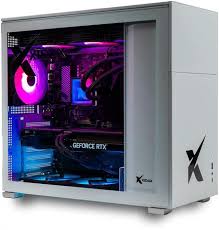
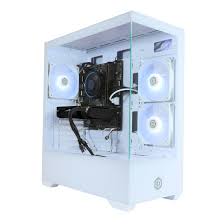
The internal layout of the Gamer Master is designed for visual cleanliness and efficient airflow. Integrated beneath the side edges of the chassis is “ambient lighting” designed to remain unseen while projecting a diffused glow across the surface beneath the case, creating a “floating” effect. The system typically features a bottom-mounted PSU shroud that conceals the power supply and excess cabling, allowing the focus to remain on the core components—the Ryzen 5 8400F and the RTX 5060 Ti.
Materials: Black-painted stainless steel with glass front and side panels.
Fans: Typically includes multiple 120mm RGB fans, with configurations often featuring three vertically mounted intake fans and one rear exhaust.
I/O Accessibility: Front bottom placement of USB-A, USB-C, and audio ports, designed for on-desk placement.
Efficient thermal management is paramount for maintaining the boost clocks of both the Ryzen 5 8400F and the RTX 5060 Ti. The CyberPowerPC Gamer Master utilizes a combination of active air cooling and, in some configurations, AIO (All-in-One) liquid cooling to manage heat dissipation.
The MA-01 chassis introduces a woven steel mesh for its top ventilation, which is engineered to minimize high-frequency resonance. Technical data suggests this mesh can reduce exhaust noise by up to 30%, making the system notably quieter than many of its competitors. Furthermore, sculpted angled vent covers are utilized to redirect intake airflow directly onto critical components like the GPU and VRMs, preventing cool air from immediately exiting the system without facilitating heat exchange.
Real-world feedback on thermals is generally positive, though it highlights the importance of fan configuration. While some entry-level SKUs have been criticized for “cheaping out” with only a single exhaust fan, leading to GPU temperatures in the 80-90 °C range, the Gamer Master configurations equipped with multiple intake fans typically see the RTX 5060 Ti peaking at a very comfortable 61 °C under load. The Ryzen 5 8400F, with its modest 65W TDP, is easily tamed by the standard air cooler, maintaining temperatures in the 60-70 °C range even during extended gaming sessions.
The Gamer Master is frequently praised for its “quiet yet powerful” operation. Under a spiriteCyberpunk 2077* session, the RTX 5060 Ti 16GB has been measured at a peak wattage of 155W, which is below its 180W TBP rating. This energy efficiency results in lower fan speeds and a less intrusive acoustic signature. Users have noted that even at 100% load, the system produces only a “light fan noise,” which is easily masked by standard gaming audio or headphones.
The primary utility of the Gamer Master is its gaming performance. Bench marking across 21 popular titles demonstrates that the Ryzen 5 8400F and RTX 5060 Ti are an exceptionally well-matched pair for 1080p and 1440p resolutions.
| Game Title | Graphics Settings | Average FPS (1080p) | 1% Lows (1080p) |
| Fortnite | Performance Mode | ~380 |
~180 |
| Valorant | Competitive | ~450 |
~210 |
| Grand Theft Auto V | Very High | ~145 |
~95 |
| Cyberpunk 2077 | Ultra (RT Off) | ~95 |
~65 |
| Lost Ark | Very High | 210 |
100 |
| Red Dead Redemption 2 | High/Ultra | ~85 |
~55 |
In these scenarios, the Ryzen 5 8400F shows no noticeable CPU bottlenecking, demonstrating that its six Zen 4 cores are more than sufficient for high-refresh-rate gaming in late 2025 and 2026.
The transition to 1440p highlights the strengths of the Blackwell architecture. While raw rasterization performance is excellent, the inclusion of DLSS 4 and Multi-Frame Generation provides a transformative experience. InIndiana Jones and the Great Circle*, the RTX 5060 Ti 16GB is able to deliver a stable experience at 1440p ultra, whereas the 8GB variant begins to stutter due to memory limitations.
With DLSS 4 enabled in Cyberpunk 2077 at 1440p, the system can boost frame rates from a native 40-50 FPS to over 100 FPS, effectively extending the lifespan of the hardware by allowing it to play the most demanding titles with visual fidelity intact. Furthermore, the system shines in “Smooth Motion” frame generation, which can lock frame rates at 140 FPS in titles like Avatar: Frontiers of Pandora, providing a degree of fluid motion previously reserved for much higher-priced enthusiast tiers.
The value of the CyberPowerPC Gamer Master must be weighed against its competitors and the cost of building a similar system from scratch during a component pricing crisis.
The “RAMpocalypse” has fundamentally shifted the DIY vs. Prebuilt debate. While building one’s own PC was historically cheaper, the rising costs of individual components like DDR5 RAM ($400+ for 32GB) and high-speed NVMe SSDs have made prebuilts increasingly attractive. A DIY build using a Ryzen 5 8400F and RTX 5060 Ti, when sourced at the lowest available retail prices, would cost approximately $910 to $1,000, not including the Windows license or the labor of assembly.
In contrast, the CyberPowerPC Gamer Master SKUs have been observed as low as $899 at retailers like Walmart during sales events. This pricing effectively provides the assembly, warranty, and OS for “free” or even at a discount compared to the retail component cost.
| Feature | CyberPowerPC Gamer Master | DIY Build (Market Price) | HP Omen 35L |
| Base Price |
~$899 – $1,127 |
~$910+ |
~$1,324 |
| CPU |
Ryzen 5 8400F |
Ryzen 5 8400F | Ryzen 5 8400F |
| GPU |
RTX 5060 Ti 8GB |
RTX 5060 Ti 8GB | RTX 5060 8GB |
| RAM |
16GB DDR5-6000 |
16GB DDR5-5200 | 16GB DDR5 |
| Upgrade Path |
High (AM5 Socket) |
High | High |
| Warranty |
1-Year Limited |
Individual Part Warranties | 1-Year Limited |
The Gamer Master competes directly with the Skytech Shadow and the HP Omen 35L. The HP Omen 35L, while often featuring a more “premium” aesthetic, is frequently priced higher (around $1,324) for similar or even slightly lower specifications, such as a standard RTX 5060 instead of the Ti variant. Skytech offers a compelling alternative with the Shadow series, sometimes bundling a Ryzen 7 7700 with an RX 9060 XT for $1,209, providing a different performance profile for those who prefer AMD’s GPU ecosystem. However, CyberPowerPC’s advantage remains its integration of the MA-01 chassis and the tactile analog controls, which offer a unique user interface not found in the more traditional designs from Skytech or iBUYPOWER.
A critical aspect of any prebuilt gaming PC is the quality of assembly and the robustness of the after-sales support network. CyberPowerPC has a complex reputation in this regard, with reviews in 2026 reflecting both high satisfaction and notable points of frustration.
Technical post-mortems of Gamer Master builds have revealed a “minimalist” approach to quality assurance. While most units function perfectly “out of the box,” a non-negligible percentage of users report assembly errors. These can range from minor annoyances, such as failing to remove internal protective foam, to critical issues like unfastened motherboards or bent pin headers on the motherboard.
Positive Findings: Most users report a “sturdy construction” with “robust materials” and professional cable management.
Critical Findings: Some units have arrived with motherboard support screws not properly threaded, leading to the component “wobbling” during transit. Furthermore, the “LED” button on certain chassis may be miswired to the reset header if the motherboard lacks a dedicated LED connector.
CyberPowerPC provides a standard one-year warranty on parts and labor. One significant drawback identified in user reviews is the RMA (Return Merchandise Authorization) policy, which requires the customer to pay for the shipping of the entire PC back to the company’s facility for repair. In early 2026, shipping a full mid-tower across the United States via UPS can cost between $176 and $330, a cost that can significantly erode the initial savings of choosing a CyberPowerPC over a more local or service-oriented brand like Dell or HP.
On a positive note, some users have reported exceptionally fast turnaround times once the unit is received, with one instance of an SSD replacement being shipped back the next day. The recommendation for prospective buyers is to consider purchasing through a retailer with a strong return policy, such as Costco, to provide an additional layer of protection against receiving a defective unit.
The true value of the CyberPowerPC Gamer Master lies in its foundation. By utilizing the AM5 socket and standard ATX components, CyberPowerPC has provided a platform that can grow with the user’s needs.
Unlike Intel’s LGA 1700 platform, which reached its “end of life” with the 14th generation, AMD’s AM5 is expected to support multiple future generations of Ryzen processors. This means that a user who starts with a Ryzen 5 8400F in 2026 could theoretically upgrade to a flagship Ryzen 9 processor in 2028 or 2029 without changing the motherboard or RAM. This significantly lowers the “total cost of ownership” over a five-to-six-year period.
Most Gamer Master configurations include a 600W to 850W power supply. While 600W is the minimum recommended for the RTX 5060 Ti, higher-tier SKUs often include 850W Gold-rated units with dedicated 12VHPWR connectors. This provides significant headroom for a future GPU upgrade, allowing a user to move to an RTX 5080 or its successor without needing to rewire the entire system.
The system’s greatest strengths are its forward-looking architecture, its innovative and aesthetically pleasing chassis design (particularly the MA-01 and its analog controls), and its exceptional value proposition compared to DIY building in the current economic climate. The RTX 5060 Ti, specifically in its 16GB variant, ensures that the system is prepared for the increasingly VRAM-heavy demands of mid-decade AAA gaming.
However, the Gamer Master is not without its caveats. The quality control inconsistencies and the potentially expensive shipping requirements for warranty repairs necessitate a degree of technical self-sufficiency or a careful choice of retailer on the part of the consumer. For those willing to perform a cursory inspection and minor troubleshooting, the Gamer Master offers a tier of performance and aesthetic refinement that is difficult to surpass in the sub-$1,500 price category.
Prioritize the 16GB Model: If the budget allows for the $50-$100 premium, selecting the 16GB VRAM variant of the RTX 5060 Ti is highly recommended to ensure long-term stability at 1440p and 4K resolutions.
Immediate Inspection: Upon delivery, users should open the side panel to ensure the motherboard is securely fastened, the protective internal foam is removed, and all power cables and fan headers are properly seated.
Retailer Selection: Purchase through a retailer with a local presence or an excellent return policy (e.g., Best Buy, Costco, Walmart) to avoid the high shipping costs associated with CyberPowerPC’s direct RMA process.
Software Cleanliness: Perform a clean installation of GPU drivers and consider a fresh installation of Windows 11 to remove any minor bloatware and ensure the most stable performance on the Blackwell architecture.
In conclusion, the CyberPowerPC Gamer Master represents the current “sweet spot” of the gaming market—a system that respects the consumer’s budget while providing a ncompromising gateway into the future of AI-accelerated gaming and the AM5 ecosystem.